Nintendo Entertainment System
- This article is about the video game console. For the application for Nintendo Switch and Nintendo Switch 2, see Nintendo Entertainment System – Nintendo Classics. For the treasure in Wario World, see List of treasures in Wario World § Greenhorn Ruins.
- "NES" redirects here. It is not to be confused with Ness.
| Nintendo Entertainment System | |||||||||
|---|---|---|---|---|---|---|---|---|---|
 Logo seen on the console  Original model of the Nintendo Entertainment System | |||||||||
| Generation | Third generation | ||||||||
| Release dates | Nintendo Entertainment System: October 18, 1985[1] October 18, 1985[1] 1986[2] 1986[2] June 1986[3] June 1986[3] September 1, 1986[4][5] September 1, 1986[4][5] September 1, 1986[4][5] September 1, 1986[4][5] September 1, 1986[4][5] September 1, 1986[4][5] September 1, 1986[4][5] September 1, 1986[4][5] January 1987[3][6] January 1987[3][6] 1987[7] 1987[7] 1987[7] 1987[7] 1987[3] 1987[3] 1987[7] 1987[7] 1987[3] 1987[3] 1987[8][7] 1987[8][7] 1987[8][7] 1987[8][7] October 1987[9] October 1987[9] Late 1987[10] Late 1987[10] 1988[11] 1988[11] October 1989[12] October 1989[12] 1990[3] 1990[3] 1991[3] 1991[3] 1991[13] 1991[13] 1991[14] 1991[14] 1992[3] 1992[3] 1993[15] 1993[15] 1993[3] 1993[3] 1993[3] 1993[3] Late 1993[16] Late 1993[16] 1994[3][17] 1994[3][17] 1994[3] 1994[3] November 14, 1994[3] November 14, 1994[3]NES Classic Edition: November 10, 2016[18] November 11, 2016[?] November 11, 2016[?] November 11, 2016[?] November 11, 2016[?] | ||||||||
| Discontinued | August 14, 1995[19] August 14, 1995[19] August 14, 1995[19] | ||||||||
| Ratings | NES Classic Edition:
| ||||||||
| Predecessors | Color TV-Game Family Computer (Asian concurrent) | ||||||||
| Successor | Super Nintendo Entertainment System | ||||||||
 - Everyone 10+
 - Seven years and older
 - Twelve years and older
 - Parental guidance
- “Now you're playing with power!”
- —Advertisement slogan for the NES
The Nintendo Entertainment System (officially abbreviated as the NES)[20][21][22] is an 8-bit home video game console created by Nintendo as the Western counterpart of the Family Computer (often named Famicom for short). It was released in the United States on October 18, 1985; British Hong Kong in 1986; Singapore in June 1986; Scandinavia on September 1, 1986; India in January 1987; New Zealand, Australia, Austria, Italy, Switzerland, Ireland, and the United Kingdom in 1987; France in October 1987; the Netherlands in late 1987; Spain circa 1988; South Korea in October 1989; Israel in 1990; Hungary and Portugal in 1991; South Africa, the Czech Republic, and Slovakia in 1993; Brazil in late 1993; Croatia in 1994; and Poland on November 14, 1994 (the latter simultaneously with the Game Boy and Super Nintendo Entertainment System).[3] Because the NES and Famicom were both released in British Hong Kong, the latter was marketed as a revision of the former rather than the other way around.[2] The South Korean and Indian editions were respectively retitled the Hyundai Comboy and Samurai Electronic TV Game System to circumvent import restrictions in both countries. In contrast to other console, this console's codename and the codename's abbreviation used for internal names and serial codes is the same.[23]
The original Nintendo Entertainment System model is a complete redesign of the Famicom, featuring a gray and white color scheme, a covered slot on the front where cartridges are slid into, and detachable controllers. The system and its launch titles contributed to revitalizing the American video game industry following the video game crash of 1983, due to its software quality control through the Official Nintendo Seal of Quality and toy-like peripherals.[24] The Nintendo Entertainment System and Family Computer sold 61.91 million units combined, and the NES was discontinued in 1995.[25][26]
Super Mario Bros. is one of the Nintendo Entertainment System launch titles, and it was frequently packaged with the system, including in the Control Deck, Action Set (as a 2-in-1 Super Mario Bros. / Duck Hunt compilation cartridge), and Power Set (as a 3-in-1 Super Mario Bros. / Duck Hunt / World Class Track Meet cartridge) bundles. It is credited as being the game that helped the industry recover from the video game crash of 1983. For decades, Super Mario Bros. was the system's best-selling game, let alone video games in general, having sold 40.24 million copies.[27] Eventually, Super Mario Bros. 3 was released in the United States, and it became an instant hit, making 500 million dollars in less than 24 hours.[citation needed]
The Nintendo Entertainment System's graphical capabilities, extended RAM, and even sound capabilities can be expanded with the use of memory mappers like the MMC2, MMC3, and MMC5. The only two Super Mario games that use memory mappers are Super Mario Bros. 2 and Super Mario Bros. 3 with the MMC3 mapper being used. The only Mario cameo appearance that uses memory mappers is Mike Tyson's Punch-Out!!, using MMC2 in particular and also being the only NES game that uses that particular mapper.
An expansion port is located underneath the Nintendo Entertainment System. It is assumed that it would have been used for a Western equivalent of the Family Computer Disk System, but it went unused. However, the redesigned NES-101 Top Loader model lacks the expansion port entirely.
Accessories[edit]
NES Controller[edit]


The NES Controller is the basic controller packaged with every Nintendo Entertainment System. It has four buttons, as well as a cross-shaped directional pad that Nintendo officially calls the +Control Pad, on a brick-shaped case. The  and
and  buttons are stationed on the right, the
  and
and  buttons are in the middle, and the +Control Pad is on the left of the controller. Nintendo later released a different form of the NES, the NES-101 model, which used a "dogbone" design instead of the brick design, which looked a lot like Super Nintendo Entertainment System controllers. This design combines elements of the Game Boy and the Super Nintendo Entertainment System controller.
Unlike the Famicom, the NES does not have any audio controls (volume slider and microphone) on the second controller. Instead, the and buttons are available on both controllers, making those practically identical. Another difference is that the NES's controllers are freely detachable, while the Famicom's hardwired ones are not.
R.O.B.[edit]
- Main article: R.O.B.
Cleaning Kit[edit]

Over time, pins inside the NES and game cartridges would get dirty. Nintendo released an approved cleaning kit to improve the condition of the contacts so games would play without interruption. Mario is on the cover of the NES Cleaning Kit.
NES Classic Edition[edit]

- Main section: Classics § NES Classic Edition
Announced on July 14, 2016, the NES Classic Edition (known as the Nintendo Classic Mini: Nintendo Entertainment System in Europe and Australia) is a smaller version of the Nintendo Entertainment System and the first entry to the Classics series. It was released in Australia on November 10, 2016, and in the Americas and Europe on November 11, 2016.[28] Unlike the original NES, the NES Classic Edition does not support cartridges, but rather features 30 games pre-installed, including Super Mario games such as Super Mario Bros., Donkey Kong, and Dr. Mario. A version for the Japanese Family Computer, the Nintendo Classic Mini: Family Computer, was released in Japan on the same day and includes a slightly different software line-up than the NES Classic Edition.
The NES Classic Edition was discontinued on April 2017,[29] but resumed production in Summer 2018.[30] On June 26, 2017, a successor was announced in the form of the SNES Classic Edition.[31]
Appearances in the Super Mario franchise[edit]

- At the beginning of the The Super Mario Bros. Super Show! episode "Mama Mia Mario", as Mario and Luigi are relaxing in front of the TV, Luigi is seen holding an NES controller.
- Similarly, at the beginning of "Time Out Luigi", Luigi uses a Zapper while playing Duck Hunt.
- The NES appears as one of Wario's treasures in Wario World.
- 9-Volt has an NES in WarioWare: Twisted!
- In Super Paper Mario, one of Francis's protected rooms has an NES, along with various other Nintendo consoles.
- In Mario + Rabbids Kingdom Battle, the design on the carpet in the Genius Girl's room is based on the NES controller.
- Though the console itself does not appear in Super Mario Odyssey, one of the filters that are available for use in Snapshot Mode is the graphics style of the NES.
- LEGO Nintendo Entertainment System, a LEGO version of the system created as part of the LEGO Super Mario partnership, was released on August 1, 2020. The set also features a Super Mario Bros. cartridge as well as a television "playing" the game and is compatible with the Mario figure from the Mario Starter Course set.[32]
- The NES D-pad is used for the plus sign in the "Nintendo + Illumination" logo in promotional adverts for The Super Mario Bros. Movie and The Super Mario Galaxy Movie.[33][34]
- In The Super Mario Bros. Movie:
- Mario owns an NES in his room in his family's apartment and is seen playing Kid Icarus on the console.
- The Toad at the antique store asks about an NES cartridge, to which the clerk tells them to blow into it, referencing a popular urban legend claiming that doing to would remove dust within the cartridge and allow it to work properly (in reality, blowing into the cartridge could risk causing further damage due to airborne saliva droplets corroding the copper connectors).
- In The Super Mario Galaxy Movie:
- The console and controllers can be seen in Mario and Luigi's room.
- Two NES Zappers can be seen in Bowser Jr.'s arsenal.
- A layout that resembles the NES controller appears on the control panel of Bowser Jr.'s security system on Planet Bowser.
- A NES controller appears in the credits.
- The structure of the prison in the mid-credits scene resembles a horizontal stack of NES cartridges.
- In The Super Mario Bros. Movie:
Promotion[edit]

A series of Australian commercials, cross-promoting Super Mario Bros., Gyromite, and Duck Hunt, feature Bowser and Lakitu. They appear alongside Smick from Gyromite, the dog from Duck Hunt, and a human spokesman, loosely resembling Max Headroom, as members of an evil version of Nintendo. In their initial appearance, they are seen as CGI characters and mock the viewer, challenging them to complete the games featured while repeatedly taunting, "You cannot beat us", while also mentioning that the player can "score one million" and "discover new worlds" in Super Mario Bros. In a later live-action commercial, a child can be seen playing Super Mario Bros. while imitating the voices from the computer-animated commercial. When he defeats Bowser and proudly shouts, "Beat ya!", Nintendo sends a gust of wind into his room that leaves him spinning, before blasting him into space.
Super Mario games[edit]
1985[edit]
1986[edit]
1988[edit]
1990[edit]
1991[edit]
1992[edit]
1993[edit]
1994[edit]
Galleries[edit]
System gallery[edit]
 Logo
Logo Alternate Logo
 Logo used on the cover for early NES games
 Logo used on the cover for later NES games in 1990 and onwards
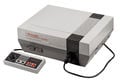 Original NES
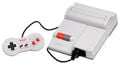 The NES-101 model
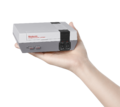 Hand holding NES Classic Edition as scale
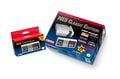 The US packaging of the NES Classic Edition
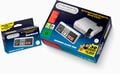 The European packaging of the Nintendo Classic Mini
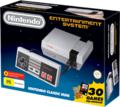 The Australian packaging of the Nintendo Classic Mini


Game gallery[edit]
This gallery does not include Family Computer games.


Miscellaneous[edit]
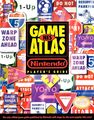 NES Game Atlas
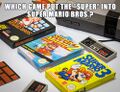 Image macro from the official NintendoAUNZ social media accounts, showing the NES alongside three Super Mario Bros. games for the system
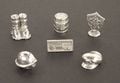 The NES Controller token (center) in Nintendo Monopoly


Names in other languages[edit]
| Language | Name | Meaning | Note(s) | Ref. |
|---|---|---|---|---|
| Japanese | ニンテンドー・エンターテインメント・システム Nintendō Entāteinmento Shisutemu | Nintendo Entertainment System | [35] | |
| Korean | 현대 컴보이 Hyeondae Keomboi | Hyundai Comboy | [36] |
References[edit]


- ^ Chris Kohler (October 18, 2010). Oct. 18, 1985: Nintendo Entertainment System Launches. WIRED (English). Retrieved November 23, 2024. (Archived November 26, 2020, 13:47:01 UTC via Wayback Machine.)
- ^ a b Akfamilyhome (April 1, 2020). A History of Nintendo's Hong Kong Releases. YouTube (Cantonese & English (English subtitles available)). Retrieved June 5, 2024. (Archived May 25, 2024, 11:22:53 UTC via Wayback Machine.)
- ^ a b c d e f g h i j k l m Joshua Rogers (December 26, 2020). World of Nintendo: Exploring Nintendo in (Eastern) Europe. PAX (via YouTube) (English). Retrieved June 5, 2024. (Archived June 5, 2024, 20:16:14 UTC via Wayback Machine.)
- ^ a b c d Tobias Bjarneby (September 29, 2006). Historien om Bergsala – 20 år med Nintendo. IDG (Swedish). Retrieved June 1, 2024. (Archived December 13, 2021, 23:23:06 UTC via Wayback Machine.)
- ^ a b c d Joe Skrebels (December 9, 2019). The Lie That Helped Build Nintendo. IGN (English). Retrieved June 1, 2